

Scotland’s epic World Cup‑sealing win over Denmark, lit up by Scott McTominay’s brilliance and raw emotion, is already being hailed as a match that will “be remembered forever” by pundits and fans alike. It was the night Scotland ended nearly three decades of World Cup exile in the most dramatic way possible, with McTominay at the heart of the story.
The night Scotland changed its history
Scotland’s 4-2 victory over Denmark came in a high‑stakes, winner‑takes‑all qualifier with a World Cup place on the line and nearly 30 years of frustration on Scottish shoulders. The national team had not reached a World Cup since the late 1990s, turning every campaign into a story of hope, near misses and heartbreak.
This time, the script was torn up in spectacular fashion, as Scotland not only qualified but did so automatically, sparing the nation the familiar lottery of play‑offs. Injury‑time drama, momentum swings and moments of individual genius combined to create a contest that felt more like a football epic than a standard qualifier.
McTominay’s defining performance
Scott McTominay entered the match already a national hero, having evolved from a hard‑working midfielder at Manchester United into a fully‑fledged talisman for both Scotland and Napoli. In this game, he produced the kind of performance that careers are remembered for, bringing leadership, physical dominance and crucial attacking thrust at exactly the moments his country needed them.
Pundits highlighted not just his goals and decisive contributions but his presence, describing him as the difference in terms of mentality and authority in the biggest moments. The same relentless mindset that has seen him thrive in Serie A under Antonio Conte was on full display, as he drove Scotland forward, demanded more from teammates and refused to let the occasion crush them.
The goal and moments that shocked the pundits
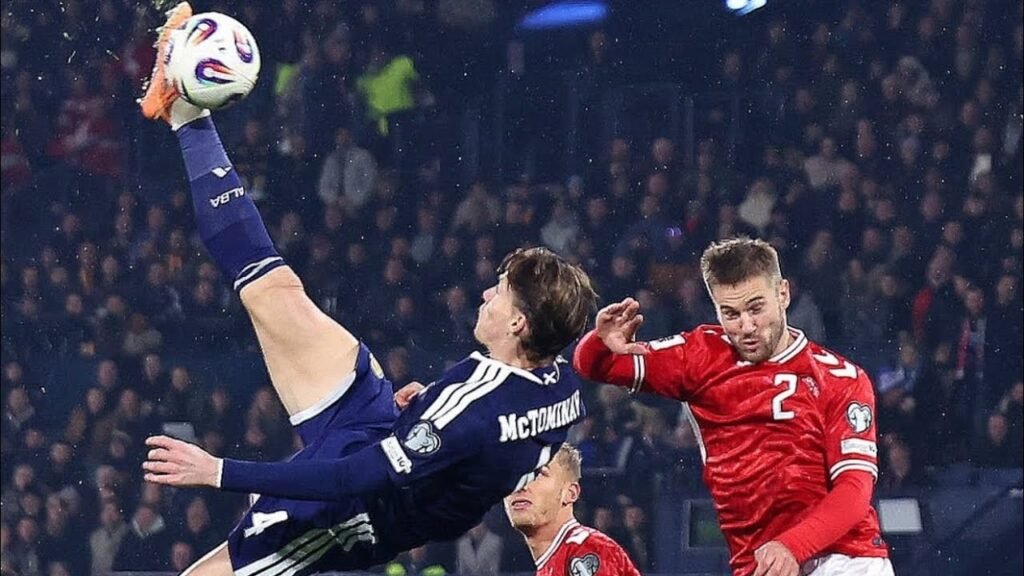
The match exploded into life early, with McTominay again proving he is a player for the biggest stages, much like his stunning bicycle‑kick goal for Napoli in the Scudetto‑clinching win days earlier. Against Denmark, his attacking runs, late surges into the box and intelligent positioning helped turn a tense tactical battle into a wild, open contest full of chances and momentum shifts.
As Scotland piled forward and the goals kept coming, television studios and commentary boxes reacted with disbelief at the scale of the transformation from decades of underachievement to ruthless, clinical finishing. The frantic closing stages, capped by injury‑time drama, pushed emotions to the limit and set up the line that would soon be repeated across platforms: this was a game nobody would ever forget.
“This game will be remembered forever”, is what the pundits meant
Former Scotland midfielder Michael Stewart captured the mood when he declared that “this game will be remembered forever”, a sentiment that quickly became the headline take from the post‑match reaction. For pundits, the result was bigger than a single night: it was the closure of a 28‑year wound and the rebirth of Scotland as a serious force on the world stage.
Commentators pointed to several layers of significance that justify the “remembered forever” tag: automatic qualification instead of play‑off agony, the sheer drama of the scoreline, the emotional images of players and fans, and McTominay’s towering influence. Many also drew parallels with famous Scottish nights of the past, arguing that this one now sits alongside, or even above, those classic occasions in the national football memory.
McTominay’s rise from doubted to indispensable
McTominay’s journey has not always been smooth, with periods at Manchester United when his long‑term role was questioned, and some critics doubted whether he could be the heartbeat of a top‑level midfield. Yet his move to Napoli under Antonio Conte unlocked another level in his game, turning him into a Serie A champion and one of the league’s standout midfielders.
Italian observers and former players have praised his mentality, describing Scottish players like McTominay as “soldiers with a mission” who blend physical resilience with tactical discipline. That mentality has transferred directly into his international displays, where he now plays as Scotland’s spiritual leader, often popping up with decisive goals and never shying away from responsibility.
The Italian chapter that forged a leader
Napoli’s title‑winning campaign, in which McTominay was described as the leading light of the side, provided the perfect proving ground for his all‑action style. Week after week, he delivered high‑intensity performances, learning to manage pressure in a football‑obsessed city and showing he could dictate games against elite opposition.
His spectacular bicycle‑kick finish in Napoli’s 2-0 win that sealed the Scudetto became an instant viral moment and underlined his growing reputation as a big‑moment player. Pundits in Scotland and Italy alike have since pointed to that winning mentality, forged in Serie A, as a key ingredient in his ability to handle the do‑or‑die stakes of the Denmark clash.
Why this match defines McTominay’s legacy
For all his club success, leading Scotland to a first World Cup in almost 30 years may stand as McTominay’s crowning achievement when his career is eventually judged. Midfielders are often measured not just by their passing or tackling statistics but by the nights when they bend history in their team’s favour, and this was one of those nights.
By driving Scotland to a 4-2 win on the biggest qualifying stage, McTominay entered the ranks of national icons, joining a select group of players whose names instantly evoke specific, emotionally charged games. For a generation of young fans who have never seen their country at a World Cup, his performance against Denmark has made him the face of a new era.
What this means for Scotland’s future
Scotland’s automatic qualification opens up a new chapter filled with opportunity, financially and emotionally, for both the national team and domestic game. The win will boost belief in the squad, strengthen the manager’s position and give the Scottish FA and coaching staff a powerful argument when convincing dual‑nationality talents to commit to the country.
Pundits have stressed that the challenge now is to ensure this is a starting point rather than a one‑off peak, using McTominay’s standards as a benchmark for what it means to represent Scotland. With key players thriving abroad in top leagues and a fanbase re‑energised by a historic night, the sense is that Scotland has finally moved from dreaming of the world stage to genuinely belonging on it.